
Guides & Inspiration
When to go to Morocco — honestly
A practical seasonal guide to choosing the right Morocco departure for your pace, route and priorities.
Read More

Money is one of those things travelers think about long before they arrive in Morocco.
How much cash should I carry? Do I tip? How much? Can I use my credit card? Am I paying too much in the souk? What should a taxi actually cost?
The good news is that Morocco is easier to navigate financially than many first-time visitors expect. The trick is understanding where cash still matters, where cards are perfectly normal, and when a few dirhams can turn a small interaction into a gracious one.
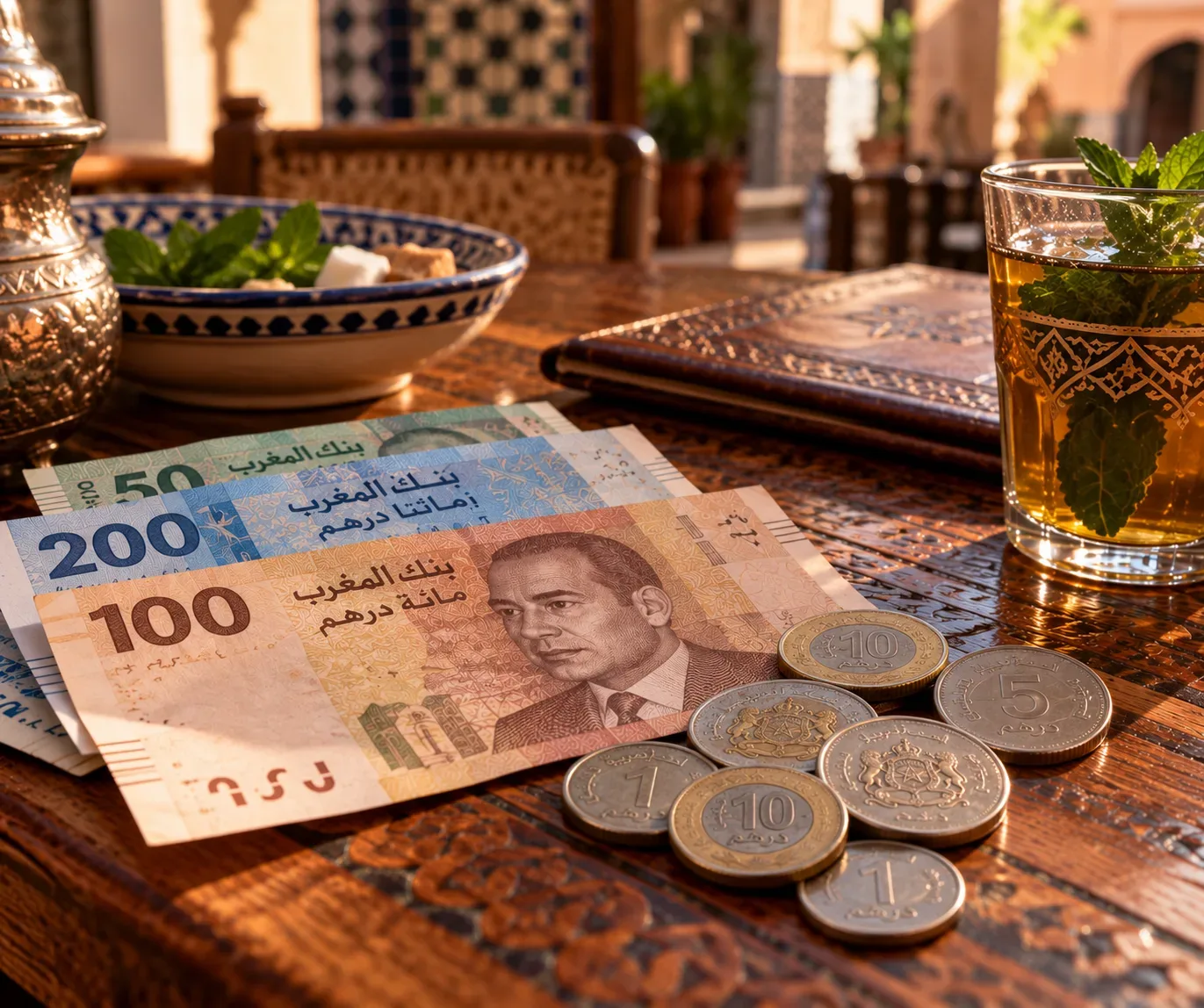
The Moroccan dirham—usually written as DH or MAD—is the country's official currency. Banknotes come in 20, 50, 100 and 200 dirham denominations, with coins used for smaller amounts. ATMs are widespread in cities, and international Visa and Mastercard cards are accepted at many hotels, restaurants, shops and petrol stations. But Morocco is not a completely cashless destination, particularly once you leave the larger cities.
So rather than trying to memorize a giant list of prices, think of money in Morocco as another part of learning how the country moves.
The first thing to know is simple: you'll want some Moroccan dirhams.
Cards are increasingly common, especially at hotels, established restaurants, larger shops and businesses serving international travelers. But smaller cafés, taxis, market stalls, local shops and many everyday transactions still work best with cash. The Moroccan National Tourist Office confirms that ATMs are widespread and that Visa and Mastercard are accepted in many hotels, restaurants, shops and petrol stations. visitmorocco.com
That doesn't mean you need to walk around with a thick wallet.
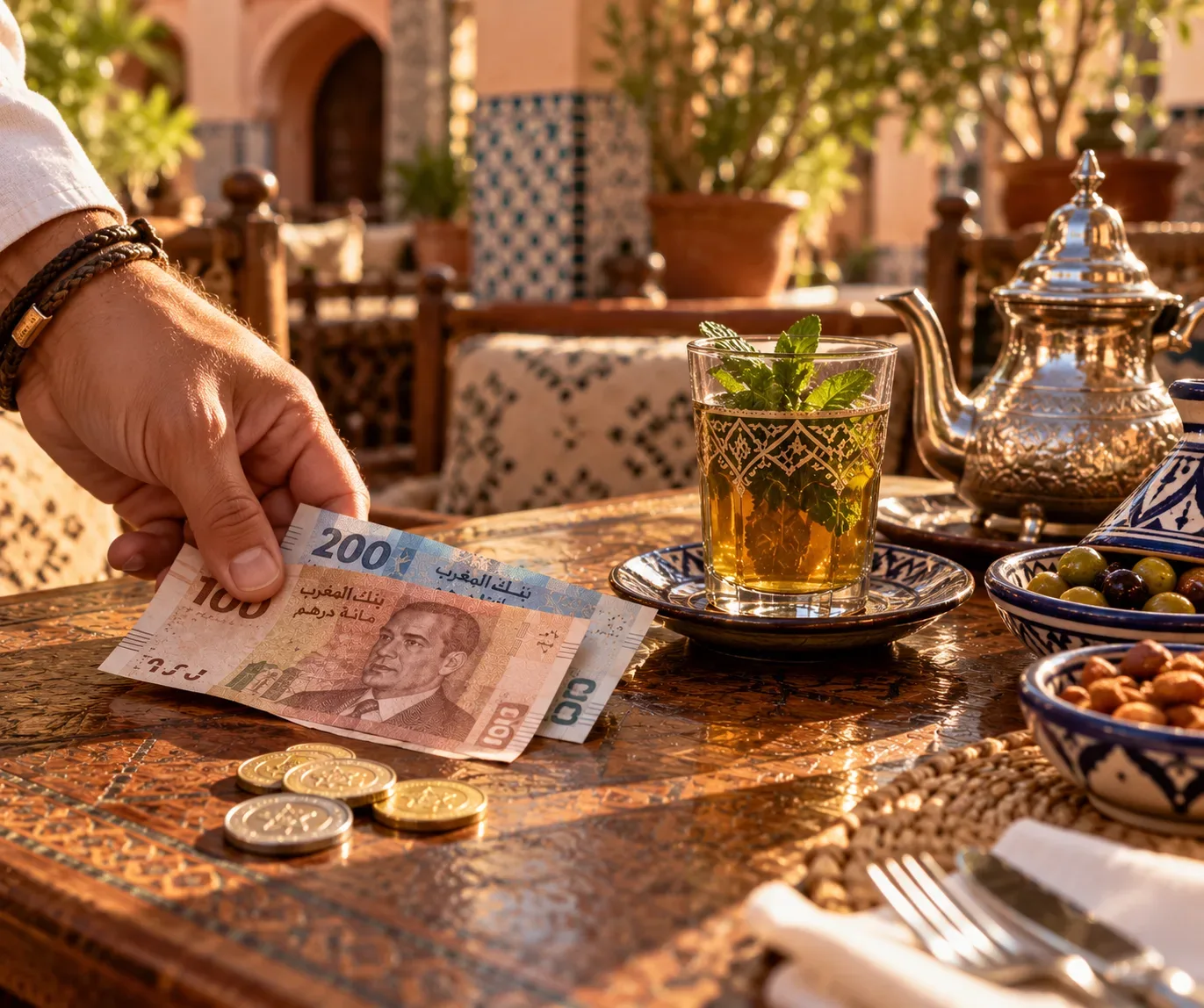
In fact, carrying smaller notes is often more useful than carrying a large amount of cash. A 20 or 50 dirham note can be much easier to use for a coffee, a small purchase, a tip or a short local service than a 200 dirham note.
Think of it this way: your card is for the bigger, structured purchases; cash is for the small moments.
And those small moments happen often in Morocco.
A coffee on a terrace. A porter helping with luggage. A quick taxi ride. A small purchase from a neighborhood shop. A tip after someone has gone out of their way to help.
You don't need to calculate every dirham before leaving home. You just need enough cash to avoid having to think about it constantly.
“Your card is for the bigger purchases. Cash is for the small moments.”
Tipping in Morocco can feel confusing to visitors from countries where tipping culture works very differently.
The simplest approach is to think of a tip as a gesture of appreciation, not an automatic percentage attached to every interaction.
At a casual café, rounding up or leaving a few dirhams is perfectly reasonable. At a restaurant, a modest tip is customary, with larger tips appropriate when the service has been particularly good. Traditional travel guidance puts restaurant tipping around 5–10% in moderate establishments and roughly 10–15% in more upscale restaurants. Rough Guides
For guides and drivers, the question is slightly different.
These people are often responsible for much more than simply getting you from one place to another. A good guide is reading the group, translating the culture, adjusting the pace, solving problems before they become problems and helping a place make sense. A good driver does the same in a different way—quietly, professionally and often for long hours.
If someone has genuinely made your journey better, a tip is an appropriate way to acknowledge it.
There is no single magic number that applies to every situation.
What matters more is the quality of the service, the length of the service, and what feels appropriate to you.
And don't worry if you don't have exact change. Moroccan service workers are accustomed to travelers learning the system.
“A tip should reflect appreciation—not anxiety about getting the number exactly right.”
This is where Morocco can become interesting.
Some prices are fixed.
Some are negotiable.
And some depend entirely on the context.
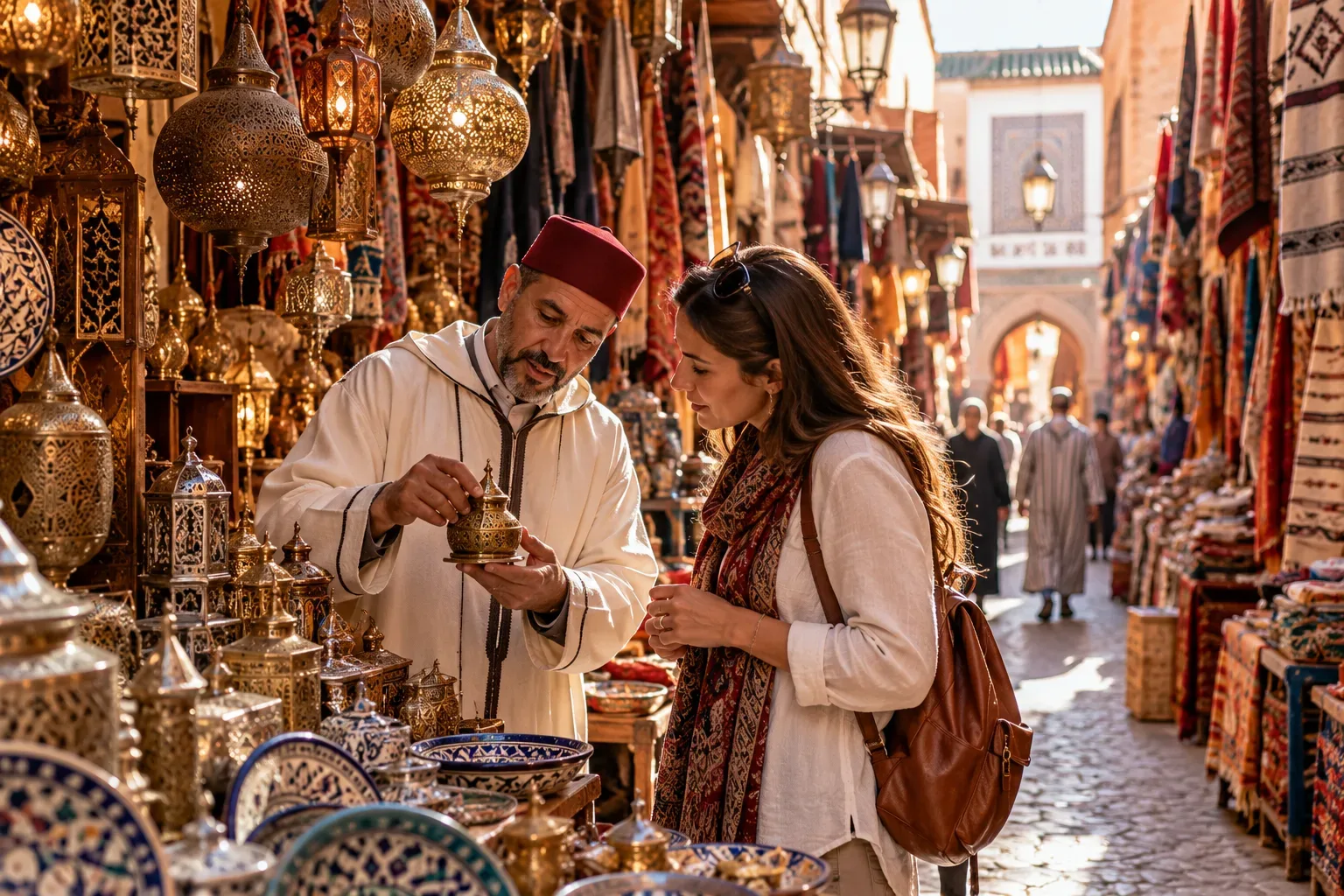
A coffee in a neighborhood café, a train ticket or a meal in an established restaurant will generally have a clear price. A handmade rug in a souk is a completely different experience.
Shopping in Morocco is often less about asking, “What is the correct price?” and more about asking, “What is this worth to me?”
Haggling is part of the culture in many markets, but it should remain a conversation rather than a confrontation. Start with a price you're genuinely comfortable paying, negotiate respectfully, and be prepared to walk away if it doesn't feel right.
You don't have to win.
That is one of the biggest mistakes visitors make.
If you negotiate for twenty minutes just to save the equivalent of a few dollars, you've probably missed the point.
The better approach is to enjoy the exchange, understand what you're buying and pay a price that feels fair to both sides.
“The goal isn't to pay the lowest possible price. It's to pay a price that feels fair.”
Some of the smallest expenses are the ones that create the most uncertainty.
A taxi. Someone carrying your luggage. A parking attendant. A small service at a hotel. A quick purchase from a local shop.
The easiest solution is to keep a handful of smaller dirham notes available rather than constantly breaking larger bills.
For taxis, always establish the arrangement before the journey when a meter is not being used. In cities where meters apply, asking the driver to use the meter can avoid unnecessary confusion. Rough Guides
And remember that not every person who helps you is expecting a large payment.
A few dirhams can be enough for a small service. If someone provides substantial help or exceptional service, you can adjust accordingly.
The principle is simple:
Don't overpay because you're uncomfortable. Don't underpay because you're trying to save every dirham.
Be fair.
For most travelers, the best strategy is not cash or card.
It's both.
ATMs are widely available in Moroccan cities, and international cards are accepted in many established businesses. visitmorocco.com
That makes it relatively easy to access money during your trip without carrying your entire travel budget with you.
When exchanging money, use established banks or reputable exchange offices and keep your passport available, as exchange counters may request it. The Moroccan National Tourist Office lists airports, banks, hotels and city exchange offices among the places where foreign currency can be exchanged. visitmorocco.com
One practical rule is worth remembering:
Don't exchange more cash than you expect to use.
You don't want to finish your trip with a large amount of dirhams simply because you were determined to exchange everything at once.
And before traveling, check what your own bank charges for international withdrawals or foreign transactions. The costs you notice most may come from your home bank rather than Morocco itself.
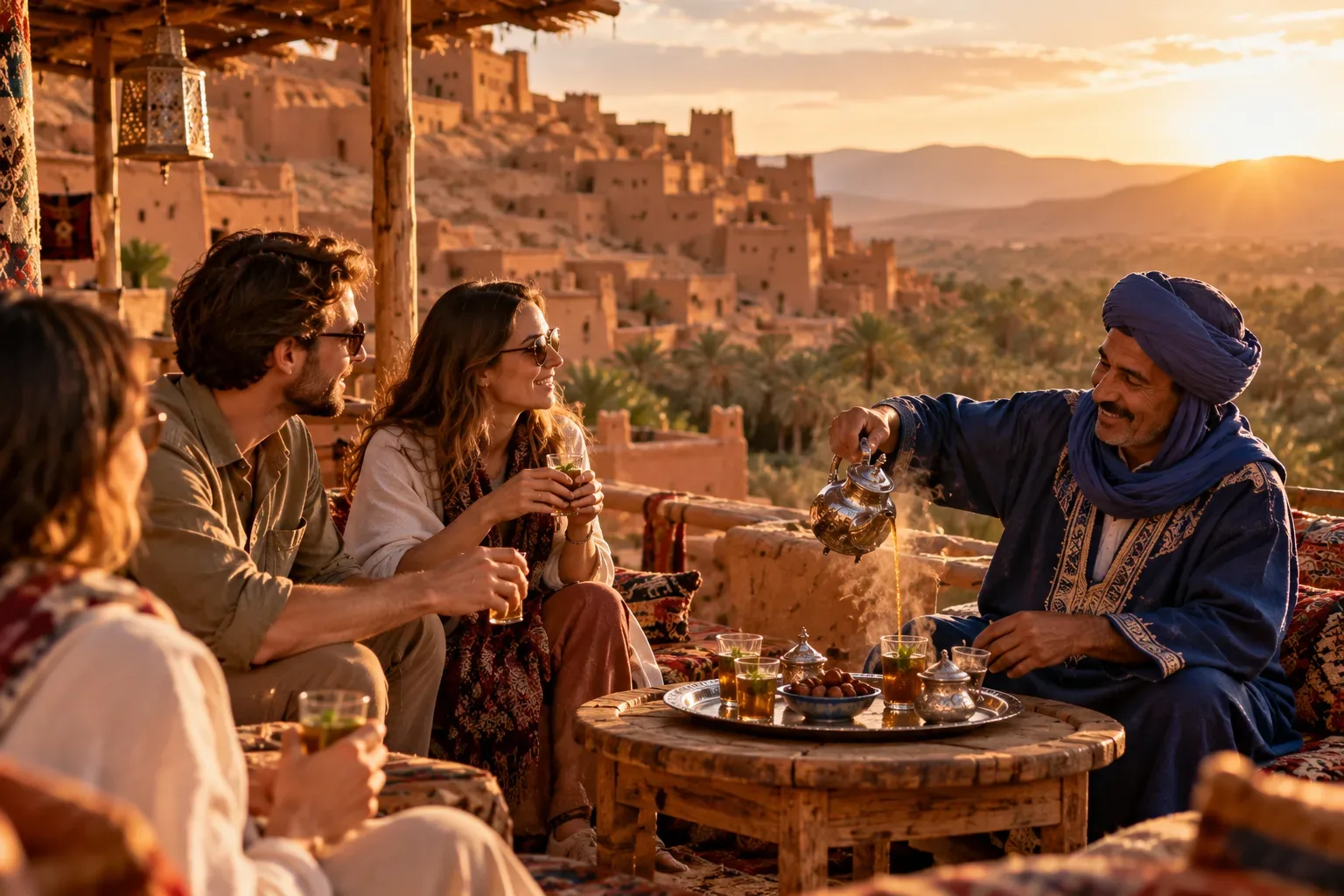
One of the reasons we encourage travelers not to obsess over a daily spending number is that Morocco is full of small experiences that aren't necessarily expensive.
A glass of tea with someone you meet.
A conversation with an artisan.
A roadside stop in the Atlas Mountains.
Fresh bread bought from a village bakery.
A bowl of harira.
A sunset walk through a quiet neighborhood.
Some of the moments you'll remember most may cost very little—or nothing at all.
That's why we prefer travelers to arrive with a sensible budget rather than a rigid one.
Pay for the things that matter to you.
Spend more when an experience genuinely deserves it.
Don't feel pressured to buy something simply because someone expects you to.
And don't measure the success of your trip by how little you spent.
Morocco is not a destination to be conquered through a spreadsheet.
It's a place to experience.
“Some of the moments you'll remember most may cost very little—or nothing at all.”
Bring a card.
Carry some dirhams.
Keep small notes.
Tip when good service deserves recognition.
Negotiate respectfully when negotiation is part of the experience.
And don't spend your entire journey wondering whether you paid 20 dirhams too much for something.
You came to Morocco to experience a country—not to become an expert in Moroccan price lists.
Once you've understood the basics, let the numbers fade into the background.
The best journeys are the ones where money stops being something you're thinking about every five minutes and becomes what it should be:
a tool that helps you experience the place you're in.
A practical seasonal guide to choosing the right Morocco departure for your pace, route and priorities.
Read More
A calm, practical look at the pressure points visitors hear about — and how to recognise them before they become stressful.
Read More
One practical packing approach for warm afternoons, cool mountain evenings, medina walking and a night in the dunes.
Read More